
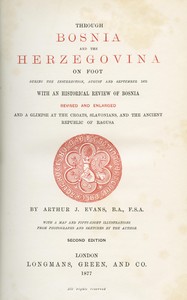
Through Bosnia and the Herzegóvina on foot during the insurrection, August and…
This isn't your typical travelogue. In the summer of 1875, Arthur J. Evans—later famous for discovering the Minoan civilization—set off on foot into a region erupting in violent revolt against Ottoman rule. The book is his day-by-day account of that journey.
The Story
Evans doesn't start with grand historical explanations. He starts with putting one foot in front of the other. We join him as he crosses from Austria-Hungary into a landscape charged with fear and rebellion. The "plot" is his route: through forests hiding rebel bands, into towns where the air is thick with rumor, and across countryside scarred by recent fighting. He meets everyone from fleeing peasants and defiant insurgents to weary Ottoman administrators. There's no single villain or hero, just a mosaic of people caught in a brutal conflict. The narrative tension comes from the constant, low-grade danger. Will this village let him pass? Is that group of armed men friend or foe? The journey itself is the drama.
Why You Should Read It
What makes this book special is its immediacy. Evans was there as history unfolded, and he writes with the urgency of someone sending a dispatch from the front lines. You feel the dust of the road and the weight of the summer heat. He's a brilliant observer, noting not just politics, but the details: the design of a local costume, the ruins of a burnt house, the tense silence of a contested valley. He's also surprisingly frank about his own fears and biases, which makes him a compelling, if not always perfect, guide. You're not getting a polished, hindsight analysis. You're getting the messy, confusing, and vivid reality of a conflict through the eyes of a sharp, curious outsider.
Final Verdict
This book is perfect for readers who love immersive history and adventurous travel writing. If you enjoyed the on-the-ground perspective of books like The Oregon Trail by Rinker Buck or the historical witness of Homage to Catalonia, you'll feel right at home. It's also a great pick for anyone interested in the complex history of the Balkans, offering a raw, primary-source view long before the wars of the 1990s. Just be ready for a journey that's more about the tense, gritty reality of a warzone than a picturesque holiday.
This title is part of the public domain archive. Knowledge should be free and accessible.
Kimberly Jackson
1 year agoBefore I started my latest project, I read this and the cross-referencing of different chapters makes it a great study tool. Truly a masterpiece of digital educational material.
Donald Thompson
6 months agoI was particularly interested in the case studies mentioned here, the narrative arc keeps the reader engaged while delivering factual content. I'm genuinely impressed by the quality of this digital edition.
John Davis
3 months agoAfter a thorough walkthrough of the table of contents, the formatting on mobile devices is surprisingly crisp and clear. This adds significant depth to my understanding of the field.
Ashley Perez
7 months agoGiven the current trends in this field, it addresses the common misconceptions in a very professional manner. I appreciate the effort that went into this curation.







Nancy White
1 year agoI decided to give this a try based on a colleague's recommendation, it manages to maintain a consistent flow even when discussing difficult topics. A mandatory read for anyone in this industry.