
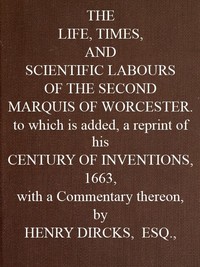
The Life, Times, and Scientific Labours of the Second Marquis of Worcester
Have you ever wondered who really invented something? That’s the question this book tackles head-on. Henry Dircks presents a passionate argument for Edward Somerset, the Second Marquis of Worcester, a 17th-century English nobleman, as the true, unsung pioneer of the steam engine.
The Story
This isn't a traditional biography with a beginning, middle, and end. Instead, Dircks builds a case, piece by piece. He introduces us to the Marquis, a man of wealth and eccentricity who lived through the English Civil War. While others fought for crowns, the Marquis was obsessed with machines. His great work was a book called 'A Century of Inventions,' a list of 100 incredible devices—from a perpetual motion machine to a water-commanding engine. The most famous of these, Device #68, is what Dircks focuses on. Using the Marquis's own cryptic descriptions and later investigations, Dircks argues this device was a functional steam-powered pump, built and demonstrated decades before Thomas Savery or James Watt entered the picture. The story follows Dircks as he pieces together evidence from old manuscripts, patents, and accounts, trying to pull the Marquis's reputation out of the shadow of being labeled a mere 'projector' or dreamer.
Why You Should Read It
What I love about this book is its fighting spirit. Dircks isn't a detached historian; he's an advocate. He’s furious that the Marquis has been overlooked, and that passion is contagious. You get to play detective alongside him, weighing the evidence. Was the Marquis’s engine practical, or just a clever idea on paper? The book forces you to think about how history is written. It’s often the winners—or those with better publicists—who get the credit. The Marquis, for all his flaws and grandiosity, becomes a strangely sympathetic figure: a man whose biggest idea was perhaps too big for his era to fully grasp.
Final Verdict
This book is perfect for readers who enjoy historical mysteries, science history, or stories about fascinating eccentrics. It’s not a light read—Dircks’s 19th-century prose can be dense, and he assumes some basic knowledge of the period. But if you’re curious about the messy, contested origins of the Industrial Revolution, and you like the idea of championing an underdog from the past, it’s incredibly rewarding. Think of it as the prequel to every steam engine story you’ve ever heard.
This is a copyright-free edition. You do not need permission to reproduce this work.
Lisa Hill
8 months agoFrom the very first page, the atmosphere created is totally immersive. A true masterpiece.







Elizabeth Rodriguez
8 months agoAs a professional in this niche, the transition between theoretical knowledge and practical application is seamless. It’s hard to find this much value in a single source these days.