
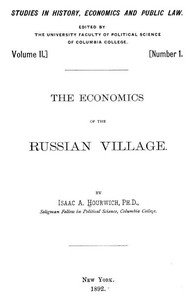
The Economics of the Russian Village by Isaac A. Hourwich
Forget the grand palaces of St. Petersburg for a moment. Isaac A. Hourwich's The Economics of the Russian Village takes us to the heart of imperial Russia: the peasant commune, or mir. This isn't a novel with characters, but a careful investigation using data from the late 19th century. Hourwich looks at tax records, land surveys, and family budgets to paint a picture of village life. He examines how land was redistributed, how taxes were collected, and most importantly, how wealth was actually distributed among families.
The Story
There's no traditional plot here. Instead, the "story" is Hourwich's argument. He challenges the popular idea of his time that the Russian village was a socialist utopia where everyone shared equally. By crunching the numbers, he shows a different reality. A small number of households controlled the best land and resources, while a growing number lived in poverty, often renting land from their wealthier neighbors. The book follows the evidence: from how the commune's decisions often favored the rich, to how rising taxes and population growth were squeezing the poor. The narrative tension comes from watching this idyllic image of peasant life get dismantled by facts and figures.
Why You Should Read It
This book is a masterclass in seeing the world through data. Hourwich makes economics human. When he talks about a family's budget, you feel the pressure they were under. It makes the vast, abstract forces of history—like the push for revolution—suddenly feel personal and inevitable. You start to understand that the social unrest that would explode in 1905 and 1917 wasn't just about political ideas in cities; it was rooted in decades of economic strain in millions of villages. It gives incredible depth to your understanding of that period.
Final Verdict
This is not a breezy beach read. It's for the curious reader who loves history and isn't afraid of some tables and statistics. Perfect for history buffs who want to go beyond the headlines of tsars and Bolsheviks, for economics students looking for a classic case study, or for anyone fascinated by how everyday economics shapes world-changing events. If you enjoy books that challenge myths and make you see a familiar historical period in a completely new light, give this a try. It's a foundational text that still resonates.
This title is part of the public domain archive. It is available for public use and education.
Charles Lopez
11 months agoImpressive quality for a digital edition.
Matthew Williams
5 months agoI've been looking for a reliable source on this topic, and the data points used to support the main thesis are quite robust. A perfect balance of theory and practical advice.
Jennifer Rodriguez
3 months agoVery interesting perspective.
Melissa Rodriguez
1 year agoHonestly, it manages to explain difficult concepts in plain English. A valuable addition to my collection.






Linda Thompson
6 months agoExactly what I was looking for, thanks!