
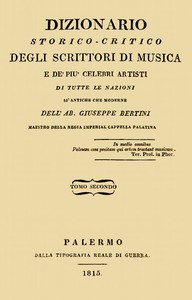
Dizionario storico-critico degli scrittori di musica e de' più celebri artisti,…
Let's be clear from the start: this isn't a novel. You won't find a twisting plot or a love story. Giuseppe Bertini's Dizionario storico-critico is something else—a massive, ambitious project to catalog the who's who of music. Published in 1814, it's a book born from worry and pride. Bertini watched as political turmoil threatened Italy's rich cultural heritage, and he decided to act. His mission? To create a definitive record of composers, performers, instrument makers, and writers on music, from the famous to the nearly forgotten.
The Story
There's no traditional narrative, but there is a powerful driving force. Bertini organizes his work like a modern encyclopedia, with entries listed alphabetically. For each person, he tries to gather the facts: where they were born, what they composed, why they mattered. He mixes dry biography with his own opinions and critiques—that's the 'storico-critico' (historical-critical) part. The 'story' is in the collective portrait that emerges. Page by page, you see an entire ecosystem of music come to life, from opera composers in Naples to violin makers in Cremona. It’s the story of a community, told one life at a time.
Why You Should Read It
I love this book because it turns history into gossip. Seriously! Flipping through it, you get these raw, unfiltered glimpses. You read about rivalries, scandals, and brilliant careers cut short. Bertini isn't a neutral robot; his voice comes through. You can tell who he admires and who he thinks is overrated. It makes these figures from centuries ago feel startlingly human. It's also a treasure hunt. For every giant like Vivaldi, there are ten names you've never heard of, each with a fascinating snippet. It reminds you that history is made by crowds, not just a few lone geniuses.
Final Verdict
This is a specialist's book, but it has magic for a specific reader. It's perfect for classical music lovers, history students, or anyone writing historical fiction who needs to understand the era's cultural landscape. It's not a cover-to-cover read; it's a book to dip into, to get lost in the footnotes of history. If the idea of exploring a pre-internet Wikipedia, written with passion and urgency, sounds fascinating, then Bertini's labor of love will feel like discovering a secret map. For everyone else, it might just be a very heavy, very old dictionary.
This book is widely considered to be in the public domain. Access is open to everyone around the world.
Linda Martin
3 weeks agoUnlike many other resources I've purchased before, the critical analysis of current industry standards is very timely. A rare gem in a sea of mediocre content.
Emily Martin
10 months agoI was particularly interested in the case studies mentioned here, the bibliography and references suggest a high level of research and authority. This is a solid reference for both beginners and experts.
Matthew Miller
2 months agoUnlike many other resources I've purchased before, the critical analysis of current industry standards is very timely. I appreciate the effort that went into this curation.
Elizabeth Johnson
5 months agoAs a long-time follower of this subject matter, the evidence-based approach makes it a very credible source of information. I feel much more confident in my knowledge after finishing this.




Sarah Harris
9 months agoThe clarity of the introduction set high expectations, and the language used is precise without being overly academic or confusing. Finally, a source that prioritizes accuracy over hype.