
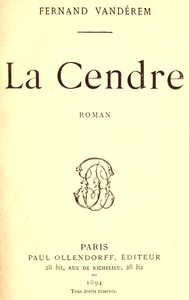
La Cendre: Roman by Fernand Vandérem
Imagine you've built a life on solid ground, only to discover it's been resting on a foundation of old secrets. That's the uneasy feeling at the heart of Fernand Vandérem's La Cendre.
The Story
We meet a successful, middle-aged man—a pillar of his community with a comfortable home and a family who adores him. His past feels like a different lifetime. Then, out of the blue, a letter arrives from Marguerite, a woman he loved in his wilder, poorer youth. She's ill and nearing the end of her life. Her request is simple: a final visit, a chance to say goodbye.
For our protagonist, this is a crisis. That passionate, impulsive young man doesn't fit into the portrait of the dignified gentleman he's painted for his wife and children. The visit is a minefield. Every shared memory, every old joke, is a threat to his present. The story follows the agonizing days leading up to their meeting and the devastatingly quiet aftermath. It's less about what happens during the visit, and more about the cracks that form in a man's soul when he's forced to confront the ghost of who he used to be.
Why You Should Read It
This book got under my skin. Vandérem, writing in the early 1900s, has this incredible eye for the tiny details of domestic anxiety. You feel the husband's tension in the way he folds a newspaper, or in the too-casual tone he uses with his wife. It's a masterclass in psychological tension without a single villain—the enemy is memory itself.
The characters feel painfully real. Marguerite isn't a vengeful figure; she's just tired and nostalgic, which makes her even more dangerous to his orderly world. And the protagonist? You'll swing between sympathy for his panic and frustration at his cowardice. It makes you wonder what versions of ourselves we've left behind in the name of 'growing up.'
Final Verdict
This is a book for anyone who loves character-driven stories that simmer rather than boil. If you enjoy authors like Edith Wharton or Henry James, but prefer something a bit more intimate and less sprawling, you'll find a friend here. It's perfect for a thoughtful reader who isn't afraid of a slow, deliberate pace—the payoff is in the haunting, quiet realism. It's not a flashy book, but its embers glow long after you've turned the last page.
You are viewing a work that belongs to the global public domain. You are welcome to share this with anyone.
Anthony Lewis
4 months agoAfter finishing this book, the content flows smoothly from one chapter to the next. I will read more from this author.
Melissa Williams
1 year agoBeautifully written.
Liam Brown
7 months agoEnjoyed every page.
Barbara Wright
1 year agoI have to admit, the narrative structure is incredibly compelling. One of the best books I've read this year.
James Williams
3 months agoMy first impression was quite positive because the author clearly has a deep mastery of the subject matter. This should be on the reading list of every serious professional.