
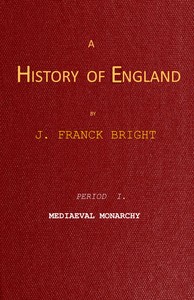
A History of England, Period I. Mediæval Monarchy by J. Franck Bright
J. Franck Bright's 'A History of England, Period I. Mediæval Monarchy' isn't a simple timeline. Instead, it follows a powerful idea: the slow, difficult birth of the English monarchy as a real governing force. Bright starts with the fragmented Anglo-Saxon kingdoms and follows the thread through the Norman takeover and into the Plantagenet era. The 'plot' is the relentless push by strong rulers to control their nobles, their land, and their laws, creating something called 'England' in the process.
The Story
Bright frames this period as a grand political project. He shows how William the Conqueror didn't just win a battle; he imposed a whole new system of land ownership and loyalty from the top down. The book then tracks the consequences: the bitter fights between kings and barons, the constant threat of rebellion, and the legal innovations, like Henry II's courts, that slowly tied the country together under royal authority. The climax of this volume isn't a single event, but the ongoing tension that finally explodes into the Magna Carta—a moment where the king's power is formally challenged and reshaped.
Why You Should Read It
What makes this old history book stand out is its focus on power—how you get it, keep it, and justify it. Bright makes you see the clever strategy behind famous events. You understand why castles were built not just for defense, but to dominate the countryside. You see royal marriages and tax policies as crucial weapons. The kings and barons feel less like statues and more like real people in a high-stakes game where the rules are being written as they play. It turns distant history into a series of gripping political dramas.
Final Verdict
This is the perfect book for anyone who finds the medieval period fascinating but intimidating. It's for the reader who watched 'The Last Kingdom' or 'The Pillars of the Earth' and wanted a clearer, deeper background on how that world actually worked. Bright is a reliable guide who explains complex feudal relationships without drowning you in jargon. While it's over a century old, its clear prose and strong central thesis make it a surprisingly accessible and insightful starting point. Just be ready for a story where the crown is always heavy, and the throne is never truly safe.
This publication is available for unrestricted use. Thank you for supporting open literature.
Sarah Rodriguez
1 month agoInitially, I was looking for a specific answer, but the author clearly has a deep mastery of the subject matter. I feel much more confident in my knowledge after finishing this.
Margaret Garcia
10 months agoFinally found a version that is easy on the eyes.
David Rodriguez
4 months agoInitially, I was looking for a specific answer, but the argument presented in the middle section is particularly compelling. It cleared up a lot of the confusion I had previously.
Jessica Lee
1 month agoThe analytical framework presented is both innovative and robust.



Jennifer Anderson
3 months agoInitially, I was looking for a specific answer, but the argument presented in the middle section is particularly compelling. A refreshing and intellectually stimulating read.