
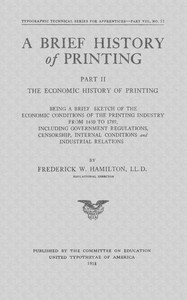
A Brief History of Printing. Part II: The Economic History of Printing by Hamilton
So, you know the basics: Gutenberg invented movable type in the 1400s, books became cheaper, and ideas spread faster. That's Part I of the story. Hamilton's book is Part II, and it asks the real-world question: Okay, but then what happened? How did this new tool make money, and who got rich (or went broke) trying to use it?
The Story
This isn't a story about one person. It's about the ripple effects of a world-changing technology. Hamilton tracks how printing moved from a specialized craft for religious texts to a sprawling commercial industry. He shows us the birth of the newspaper, the magazine, and the cheap novel. He explains how printing created new markets, from political pamphlets to product catalogs. The book walks through the economic challenges printers faced: securing capital for expensive presses, finding reliable paper suppliers, navigating early copyright laws, and competing in crowded markets. It's the business history behind the books on your shelf.
Why You Should Read It
I loved this because it connects dots I never thought about. You start to see how the printing press wasn't just a tool for philosophers; it was the engine for the first 'information economy.' Hamilton makes you appreciate that the struggle to monetize content, protect intellectual property, and reach a wide audience isn't a modern problem—it's as old as printing itself. Reading about 18th-century printers hustling to sell subscriptions or dealing with paper shortages feels weirdly familiar. It gives a whole new depth to the history we think we know.
Final Verdict
This is a must-read if you're a history fan who enjoys seeing how technology and economics collide. It's perfect for business-minded readers curious about the origins of media and marketing, or for any book lover who wants to understand the economic forces that literally put words on the page. It’s not a dry textbook; it’s a look at the gritty, ambitious, and often chaotic business behind the spread of knowledge. You'll never look at a newspaper or a paperback the same way again.
There are no legal restrictions on this material. Feel free to use it for personal or commercial purposes.
Anthony Robinson
1 year agoCompatible with my e-reader, thanks.
Ava Wright
9 months agoBased on the summary, I decided to read it and the character development leaves a lasting impact. I will read more from this author.
David Scott
1 year agoI started reading out of curiosity and the plot twists are genuinely surprising. Exactly what I needed.
Barbara Anderson
2 months agoNot bad at all.


Steven Harris
6 months agoI came across this while browsing and the flow of the text seems very fluid. I learned so much from this.