
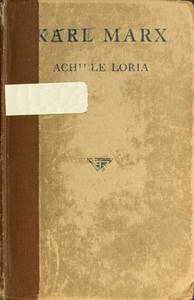
Karl Marx by Achille Loria
Let's be clear from the start: this isn't your typical biography. Achille Loria's book on Karl Marx is something much stranger and more interesting. Loria was a prominent economist in his own right during the late 19th and early 20th centuries, but he built his career in part by positioning himself as a critic of Marx's revolutionary ideas. So, when he sets out to write about Marx, he's not a neutral observer. He's a contestant in the ring.
The Story
The book walks through the core of Marx's thought—the materialist conception of history, the labor theory of value, the idea of inevitable class conflict leading to revolution. Loria explains these concepts, but his explanations are always leading somewhere: to a critique. He tries to poke holes in Marx's logic, arguing that economic factors aren't the only drivers of history, that Marx's predictions were too rigid, and that his entire system was built on shaky ground. The 'plot' is the clash between two worldviews: Marx's sweeping, revolutionary vision versus Loria's more gradualist, reform-minded alternative.
Why You Should Read It
I loved this book because it forces you to think. You're not just absorbing Marx's ideas; you're constantly being asked to defend them or consider their weaknesses. Loria isn't always fair, and modern scholars have pointed out his misunderstandings, but that's part of the appeal. It shows how ideas were fought over in real time. Reading it feels active, like you're part of the conversation. You get a raw look at the intellectual battles that shaped economic thinking long before these debates settled into textbook chapters.
Final Verdict
This book is perfect for readers who already have a basic grasp of Marx and want to see his ideas challenged from a historical perspective. It's for the curious person who enjoys seeing great minds in conflict. It's definitely not a balanced introduction—for that, you'd want a modern biography. But if you want to understand how Marx was perceived and opposed by a contemporary critic, and if you enjoy the messy, argumentative side of intellectual history, this is a fascinating and unique read. Just be ready to argue with the author in your head.
This digital edition is based on a public domain text. You do not need permission to reproduce this work.
Edward Nguyen
1 year agoLoved it.

Edward King
1 year agoJust what I was looking for.