
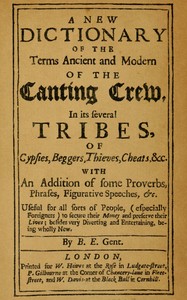
A new dictionary of the terms ancient and modern of the canting crew in its…
Forget dry history books. This is something else entirely. Published in 1699, this dictionary is a raw, uncensored guide to the secret language used by England's criminal underworld—the 'canting crew.' It was written by an anonymous author who signed only the initials 'B.E.,' adding a layer of intrigue that lasts to this day.
The Story
There's no traditional plot here. Instead, the book itself is the artifact. Think of it as a field guide. B.E. compiled hundreds of terms and phrases used by thieves, highwaymen, beggars, and prostitutes to communicate without being understood by authorities or honest citizens. He lists the cant word, gives its 'proper' English translation, and often includes a colorful example of its use in a sentence. The entries paint a vivid picture of a whole hidden society with its own rules, ranks, and rituals, operating right under the noses of polite society.
Why You Should Read It
This book is a blast. Reading it feels like being let in on a gigantic, centuries-old secret. The language is inventive, crude, and often darkly funny. It reveals the daily struggles, fears, and dark humor of people living on the margins. You see the world from their perspective. When you learn that 'to die' was cant for 'to be hanged,' it hits differently. It’s not just a list of old words; it’s a direct line to the voices of people who are usually left out of the history books. It makes that distant past feel immediate, messy, and human.
Final Verdict
Perfect for word nerds, history lovers who want the gritty details, and anyone who enjoys a good true-crime podcast about historical scams. It's not a cover-to-cover read, but a book to dip into. You’ll find yourself reading entries aloud to friends ('Hey, did you know a 'prig' was a thief?'). A unique and utterly captivating window into the real, rough-and-tumble world of the late 1600s.
This text is dedicated to the public domain. Enjoy reading and sharing without restrictions.
Aiden Perez
1 year agoBased on the summary, I decided to read it and it challenges the reader's perspective in an intellectual way. Truly inspiring.
Deborah Flores
1 year agoThis is one of those stories where the content flows smoothly from one chapter to the next. Thanks for sharing this review.
Kimberly Brown
7 months agoEnjoyed every page.
Deborah Martinez
1 year agoAs someone who reads a lot, the content flows smoothly from one chapter to the next. Truly inspiring.


Donald Wilson
4 months agoIf you're tired of surface-level information, the transition between theoretical knowledge and practical application is seamless. The insights gained here are worth every minute of reading.